
Office and commercial cleaning costs in Whitby depend on your usable floor area, attendance, cleaning frequency, washrooms, flooring and any special requirements—not a single citywide rate. For 2026, the practical approach is to request an itemized scope, schedule cleaning around actual occupancy and use a room-by-room checklist to verify the work. Whitby businesses should also account for winter salt, shared-building responsibilities and the difference between routine office cleaning and specialized commercial work.
Key takeaways
- Compare written scopes before comparing prices; similar-looking quotes may cover different tasks.
- Match cleaning to busy days, visitor traffic and hygiene needs rather than your lease size alone.
- Plan extra entrance care for Whitby’s wet, snowy and slushy weather.
- Separate routine cleaning from periodic floor care, detailed work and specialized procedures.
- Ask how concerns are reported, corrected and followed up—not just how crews are scheduled.
How much does office cleaning cost in Whitby in 2026?
Office cleaning costs in Whitby are site-specific, with the largest differences usually coming from the amount of work required and how often it must be completed.
A quiet professional office in Brooklin does not need the same scope as a customer-facing business in downtown Whitby or an office attached to an industrial facility near Highway 401. Even similarly sized premises can differ in washroom use, entrances, floor finishes and opening hours.
| Cost driver | What to clarify during a walkthrough |
|---|---|
| Square footage and layout | Which rooms are included, and how much floor space is accessible? |
| Cleaning frequency | Which days need a full reset, and where are interim checks needed? |
| Traffic and attendance | How many employees, customers and visitors use the space? |
| Washrooms and kitchens | How many fixtures and shared food areas require attention? |
| Flooring | Are there carpets, resilient floors, tile or finishes needing special care? |
| Special requirements | Are there clinical protocols, restricted rooms or narrow access windows? |
| Consumables | Who supplies soap, paper products and bin liners? |
Use Arelli’s office cleaning pricing guide to understand these cost drivers, then request a site-specific assessment. Ask whether periodic tasks are included or quoted separately. A lower recurring price is not necessarily a saving if essential work keeps appearing as an unexpected extra.

What should a Whitby commercial cleaning quote include?
A useful commercial cleaning quote should identify the areas, tasks, frequency, exclusions and responsibilities that determine the service you receive.
“Clean office” is too vague to manage. “Vacuum accessible carpeted areas, clean washroom fixtures and damp-mop the entrance each scheduled visit” gives both the manager and crew something concrete to check.
Before accepting a proposal, confirm:
- Service boundaries: private premises, shared corridors, stairs and common washrooms.
- Task frequency: every visit, selected visits or periodic appointments.
- Supplies and equipment: what the cleaner brings and what your business provides.
- Access arrangements: keys, alarms, parking and lock-up responsibilities.
- Exclusions: elevated surfaces, exterior windows, hazardous materials and moving heavy furniture.
- Follow-up: who receives concerns and how completion is confirmed.
For leased premises, check the property manager’s scope first. Paying a tenant cleaner to duplicate common-area work wastes budget, while assuming someone else cleans the shared entrance creates a gap. Arelli’s Whitby cleaning services provide a starting point for discussing your local premises and service needs.
How often should a Whitby office be cleaned with hybrid staff?
A hybrid office should be cleaned according to occupied days, shared-space use and visitor traffic, with higher attention after busy attendance periods.
An office that is quiet at the start of the week but full for team meetings later needs a different schedule from one with steady daily attendance. Reducing every task equally can leave kitchens and washrooms underserved while little-used rooms receive unnecessary attention.
Use this as a planning framework, not a universal prescription:
| Area | Starting schedule to discuss | Increase attention when |
|---|---|---|
| Entrances and reception | Each occupied day, with checks as needed | Slush, rain or customer traffic builds up |
| Washrooms | Each occupied day; additional checks according to use | Supplies run low or fixtures become visibly soiled |
| Shared kitchen | Each occupied day and after food spills | Group lunches or meetings increase use |
| Desks and workstations | Scheduled visits, where surfaces are cleared | Desks are shared or visibly soiled |
| Meeting rooms | After busy use and during scheduled cleaning | Rooms turn over between groups |
| Low-use private rooms | Lower frequency based on inspection | Occupancy or dust accumulation changes |
These tasks do not all require a contractor visit: assign any between-visit checks to a named onsite contact. Build your office cleaning schedule around occupancy patterns, then review it when staffing, hours or customer visits change.
What belongs on a practical office cleaning checklist?
A practical checklist names observable tasks by area and separates routine work from periodic detail cleaning.
The checklist should make it easy to distinguish a missed task from an excluded one. It should also protect employees’ belongings and sensitive business information.
At each scheduled visit, where included
- Empty designated waste and recycling bins and replace liners as needed.
- Vacuum accessible carpeted areas and clean hard floors using suitable methods.
- Clean washroom fixtures, counters and touchpoints; replenish agreed supplies.
- Clean kitchen counters, sinks and accessible appliance exteriors.
- Clean designated touchpoints such as handles and switches.
- Wipe cleared, approved desk surfaces without moving documents.
- Remove fingerprints from reachable entrance glass.
- Report leaks, damage, inaccessible areas and supply shortages.
On an agreed periodic schedule
- Detail accessible ledges, baseboards, chair bases and partition surfaces.
- Clean appliance interiors only where specifically included.
- Inspect carpet traffic lanes and hard-floor finishes for further treatment.
- Review entrance mats and neglected edges behind accessible furnishings.
Outside routine scope unless agreed
Carpet extraction, floor refinishing, post-construction dust removal and difficult-access glass should be discussed separately. Review specialty cleaning options rather than assuming an ordinary service visit includes them.
How should Whitby businesses handle winter salt and seasonal dirt?
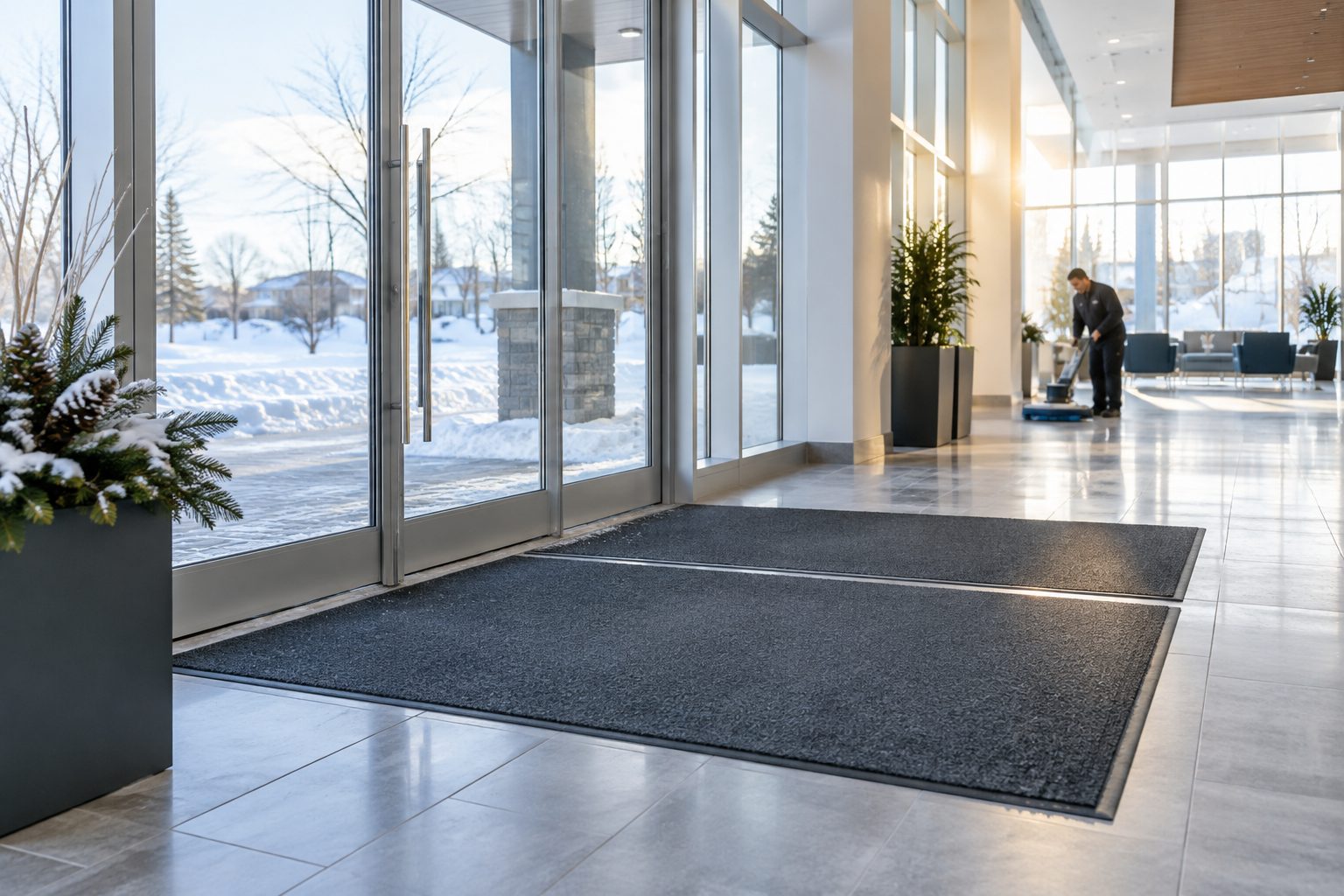
Whitby businesses should treat seasonal entrance care as a changing workload, not a fixed task that takes the same effort year-round.
A reception floor beside a street-facing door may need more attention after a slushy morning than it does during a dry week. Offices connected to industrial operations can also receive tracked-in grit from staff moving between work areas.
Focus on a few practical controls:
- Keep entrance mats flat and inspect them for saturation or curling.
- Remove loose grit before wet cleaning to reduce abrasion.
- Use floor-compatible products and methods for salt residue.
- Assign daytime checks when weather creates wet walking surfaces.
- Keep cleaned areas appropriately controlled until floors are dry.
Decide who handles a wet entrance between scheduled visits. An evening crew cannot address slush tracked in during morning arrivals unless daytime coverage is arranged. In warmer months, adjust attention toward tracked-in soil, pollen and entrance glass rather than carrying winter priorities forward unchanged.
What hygiene and green-cleaning standards should you request?
Request a written approach that matches cleaning methods, disinfectant use and product selection to the surfaces and risks in your workplace.
Cleaning removes soil; disinfection uses an appropriate product to inactivate microorganisms according to its label. Where disinfection is needed, the crew should follow instructions for preparation, dilution, surface compatibility and contact time. A quick spray and immediate wipe may not meet those instructions.
For lower-impact cleaning, ask practical questions rather than accepting a broad “green” label:
- Can the contractor identify the products proposed for your site?
- Are fragrance sensitivities considered?
- Are products diluted and used according to their labels?
- Are reusable cloths managed to avoid transferring contamination between areas?
- Does waste handling follow your building’s collection arrangements?
Do not equate a pleasant scent with cleanliness or assume an environmentally preferred cleaner is also a disinfectant. Whitby clinics should align cleaning with applicable infection-prevention requirements and facility protocols; ordinary office procedures are not a substitute for clinical cleaning instructions.
How does commercial cleaning differ between Whitby business types?
Commercial cleaning should reflect how each business uses its premises, rather than applying an office checklist to every setting.
A downtown storefront needs entrance glass, customer-facing floors and fitting or service areas addressed without disrupting visitors. A professional office may place greater emphasis on meeting rooms, confidentiality and predictable after-hours access. A warehouse-connected office needs clear boundaries between administrative areas and operational zones.
For commercial cleaning, identify the work the crew is authorized to perform. Warehouse machinery, production equipment, clinical equipment and hazardous spills should never be casually added to a general cleaning checklist.
In shared premises, document who cleans common washrooms and lunchrooms. For property managers overseeing several units, use consistent inspection criteria while allowing each tenant’s scope to differ. This makes service easier to evaluate without pretending every business generates the same workload.
How do you choose a reliable cleaning company in Whitby?
Choose a cleaning company that can explain its scope, staffing, access procedures and issue-resolution process clearly before work begins.
A walkthrough reveals more than a generic proposal. Show the contractor the entrance during normal use, identify sensitive rooms and explain where complaints tend to arise. Ask how service adjusts when attendance increases or winter conditions change.
Compare providers on:
- Written inclusions, exclusions and periodic tasks.
- Insurance documentation and worker training appropriate to the site.
- Key, alarm and confidential-information procedures.
- Arrangements for staff absences and continuity.
- Reporting, corrective action and follow-up.
- Cancellation terms and quote-comparison conditions.
Arelli uses local crews, not a franchise, and serves 300+ Ontario businesses. Its service includes no cancellation fees, 24/7 client support and an Arelli client app for reporting concerns and following up. Review client care alongside the cleaning scope: support access is useful, but specific response arrangements should still be clear.
Frequently asked questions
These answers address common decisions Whitby managers face when arranging cleaning.
Can I get a Whitby cleaning quote without a walkthrough?
You can start with floor area, photos, operating hours and a list of required tasks. A walkthrough helps confirm washroom demand, floor conditions and access constraints before the scope is finalized.
Is after-hours cleaning better than daytime cleaning?
After-hours cleaning generally reduces disruption during floor care and routine resets. Daytime attention is useful when entrances, washrooms or shared kitchens need checks while the building is occupied.
Can a hybrid office reduce cleaning frequency?
Yes, where lower attendance genuinely reduces the workload. Keep checks in place for occupied washrooms, food areas and spills rather than reducing every task automatically.
Are cleaning supplies included in the price?
That depends on the written agreement. Distinguish cleaning chemicals and equipment from consumables such as hand soap, paper towels and toilet tissue, and assign responsibility for ordering them.
Does Arelli offer a price match in Whitby?
Arelli offers Price Match on comparable written quotes. Compare areas, tasks, frequency and exclusions so the proposals cover equivalent work.
Can I try Arelli before committing?
Arelli offers a free 45-minute sample clean before you commit. Agree on a representative area beforehand so you can assess the work and communication without expecting a full-building clean.
Get a free sample clean
A free 45-minute sample clean lets you assess Arelli’s approach before committing to ongoing service. Explore cleaning services in Whitby, then book your free sample clean to discuss your premises, schedule and priorities for 2026.
Arelli service for this topic
Commercial Cleaning in Whitby