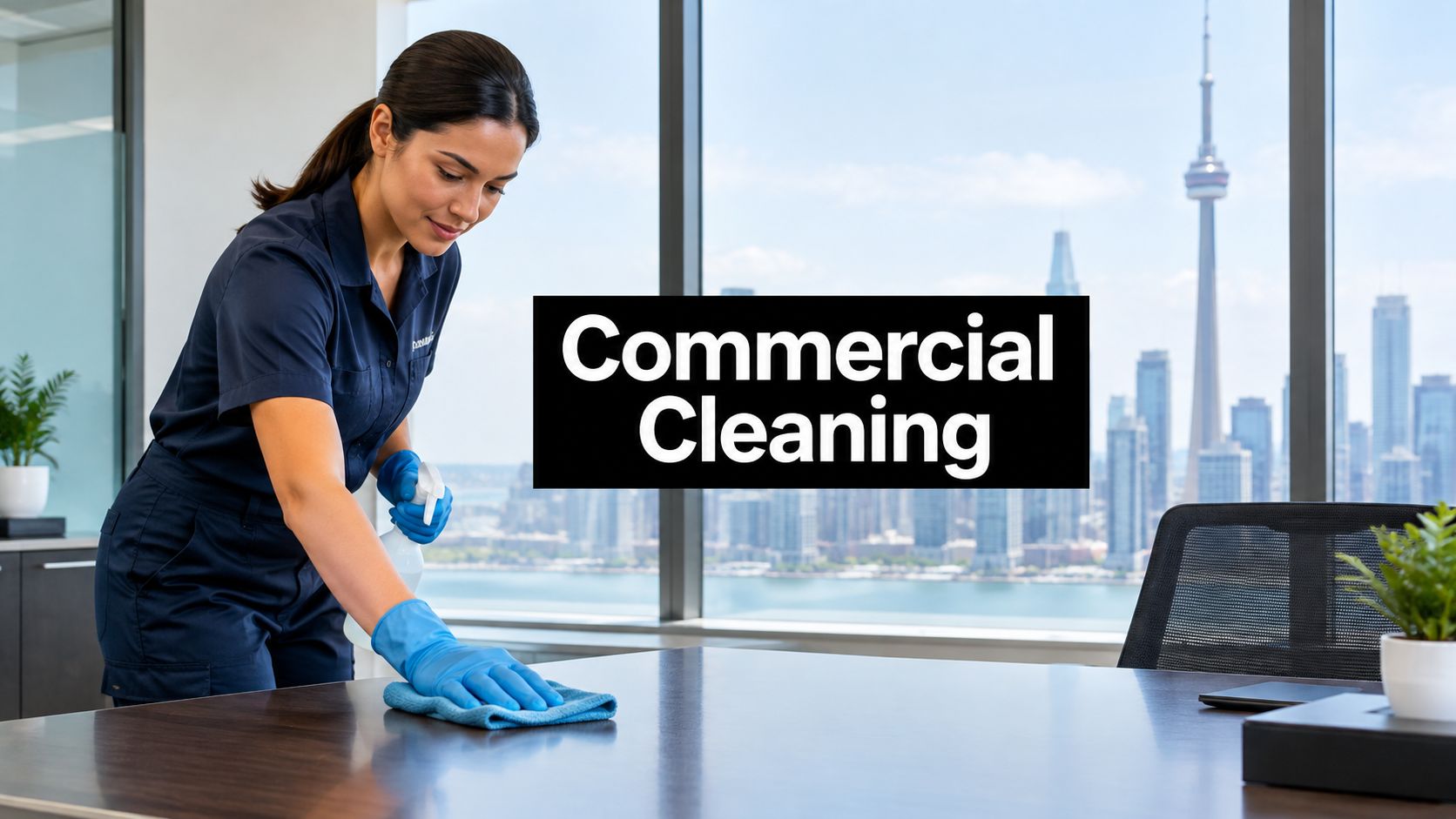
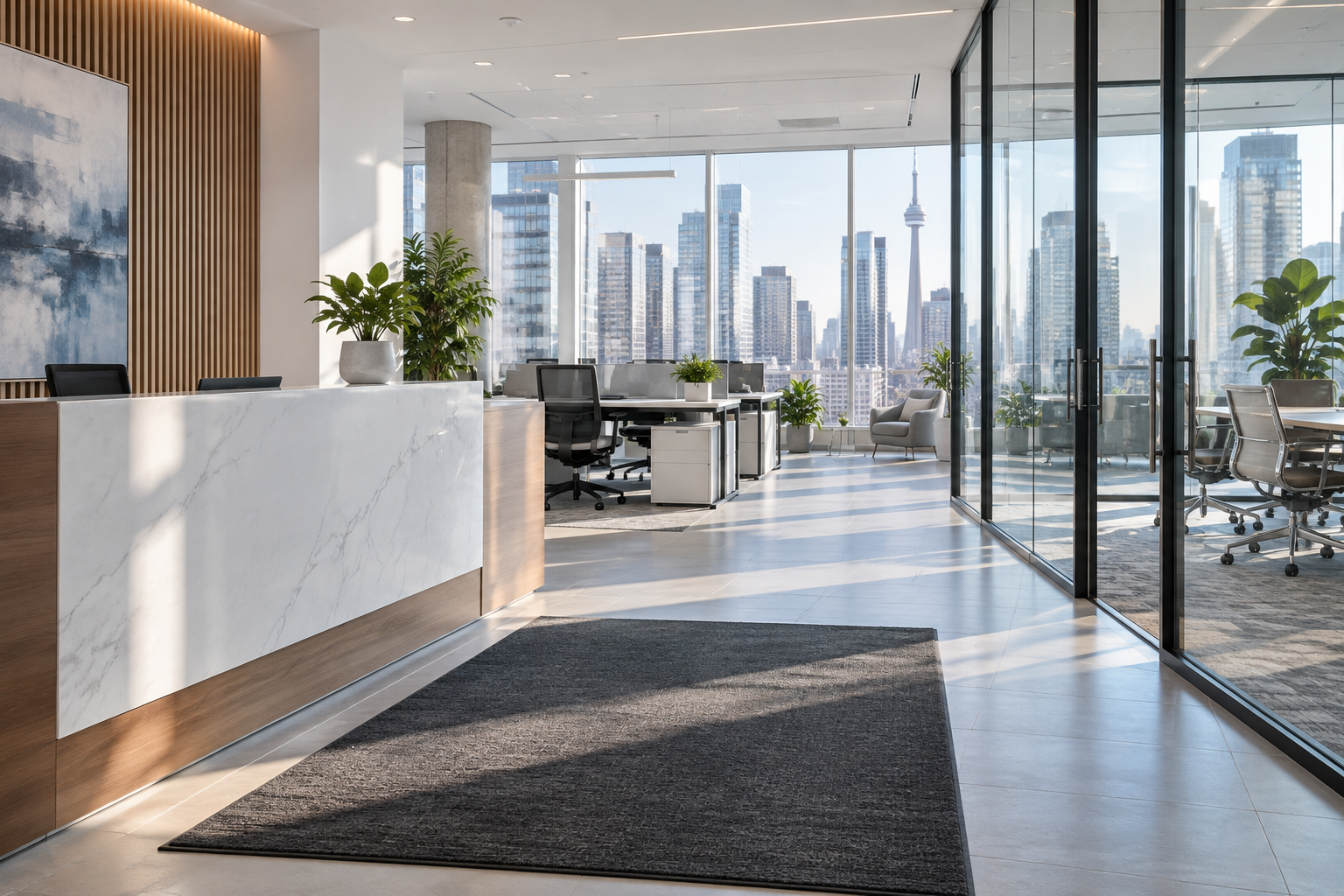
Office building cleaning in Toronto should follow a room-by-room scope that defines tasks, frequencies, access rules and responsibility for tenant versus shared building areas. For Offices & Administrative Spaces, the priorities are washrooms, kitchens, entrances, shared workstations and meeting rooms, with adjustments for hybrid attendance and winter salt. A useful scope also identifies exclusions, periodic work and how concerns are reported, so facility managers can compare quotes on the same basis.
Key takeaways
- Separate landlord-controlled common areas from tenant-controlled office space before requesting quotes.
- Schedule around actual attendance, meeting bookings and visitor traffic—not square footage alone.
- Give each room a task list, frequency and clear completion standard.
- Address Toronto winter salt, wet entrance mats and contractor access in the written scope.
- Distinguish routine cleaning from disinfection, periodic floor care and specialist work.
What should an office building cleaning scope include?
A complete scope should identify every serviced area, the tasks performed there, their frequency and who supplies materials or authorizes additional work.
In a Toronto office tower, a tenant's reception may sit beside a corridor maintained by the landlord. In a converted commercial building, the tenant may also be responsible for the entrance stairs and washrooms. Neither arrangement should be assumed.
Before comparing commercial cleaning services, walk the property with the proposed provider and mark the service boundary on a floor plan. Include storage rooms, internal stairs and bookable rooms that are easy to miss.
Record these details beside each area:
- Floor material and any manufacturer care restrictions.
- Occupancy, visitor traffic and usual busy periods.
- Approved access hours, keys, fobs and alarm procedures.
- Responsibility for paper products, soap, liners and waste transfer.
- Excluded surfaces, equipment and restricted rooms.
For multi-tenant office buildings, confirm who cleans elevator interiors, shared washrooms and the route to the waste room. A gap between contracts can leave those areas unassigned.
How often should each office area be cleaned?
Cleaning frequency should reflect use and risk, with frequently used washrooms, kitchens and entrances receiving more attention than quiet storage or enclosed offices.
The following table is a planning baseline, not a universal service requirement. Review it against your busiest occupied days and building conditions.
| Area | Routine scope | Suggested planning frequency | Periodic or conditional work |
|---|---|---|---|
| Reception and entrances | Remove grit, clean accessible glass, empty bins, clean floors | Each occupied day; inspect during wet weather | Mat extraction and detailed floor care |
| Workstations | Clean accessible cleared surfaces, shared touchpoints and surrounding floors | Based on attendance; shared desks between users under an agreed process | Detailed dusting and carpet extraction |
| Meeting rooms | Wipe tables, remove waste, clean touchpoints and floors | After busy booking periods and during scheduled cleaning | Upholstery and detailed edge cleaning |
| Kitchens and lunchrooms | Clean counters, sinks, tables, appliance exteriors and floors | Each occupied day; spot-clean after meal periods | Appliance interiors if included |
| Washrooms | Clean fixtures, disinfect specified touchpoints, replenish supplies, clean floors | Each occupied day, with checks based on demand | Scale removal and detailed grout cleaning |
| Corridors and internal stairs | Remove debris, clean floors and handrails | According to traffic | Floor maintenance and edge detailing |
| Storage and utility rooms | Clean accessible floors and permitted surfaces | Scheduled according to use | Work requiring equipment access or specialist handling |
For hybrid offices, keep an attendance-based schedule rather than reducing every task equally when headcount falls. Washroom and kitchen needs remain even on quieter days.
What belongs in the reception, entrance and corridor scope?
Entrance cleaning should control tracked-in moisture and grit while keeping visitor-facing surfaces presentable throughout occupied hours.
Toronto winter conditions make this more than an appearance issue. Salt residue and slush can move from an entrance mat into hard-floor corridors and carpeted reception areas. A nightly visit may not address moisture that accumulates during the morning arrival period.
Specify:
- Vacuuming entrance mats and checking for saturation or curled edges.
- Removing dry grit before damp cleaning hard floors.
- Using floor-compatible methods to remove salt residue.
- Cleaning door handles, push plates and accessible glass.
- Reporting damaged mats, persistent wet spots or flooring defects.
Where an office connects to the PATH or a shared lobby, confirm the precise boundary of the tenant's cleaning responsibility. The building's traffic patterns may bring moisture through a different door than the main street entrance.
Agree on who responds to daytime spills and who replaces saturated mats. Cleaning does not replace repair, mat servicing or building maintenance.
What should cleaners do at desks and shared workstations?
Workstation cleaning should cover accessible, cleared surfaces and shared touchpoints without disturbing confidential documents or sensitive equipment.
Administrative offices handle personnel files, financial records and other private information. The scope should instruct cleaners not to move paperwork, open drawers or reorganize desks to reach a surface. Establish a clear-desk expectation with employees instead.
Include in the routine scope
- Cleared desktop surfaces and accessible desk edges.
- Shared touchpoints using suitable products and methods.
- Waste and recycling collection under the agreed sorting rules.
- Vacuuming accessible carpet, including beneath unobstructed desks.
- Dusting accessible ledges and furniture surfaces.
Define separately
Keyboards, monitors, docking stations and desk controls need equipment-compatible instructions. Do not assume that general surface products are suitable for electronics.
For hot desks, decide whether users, daytime staff or the evening crew handle between-user cleaning. Scheduled office cleaning can reset the space overnight, but it cannot address every workstation change during the working day.

How should meeting rooms and client-facing rooms be cleaned?
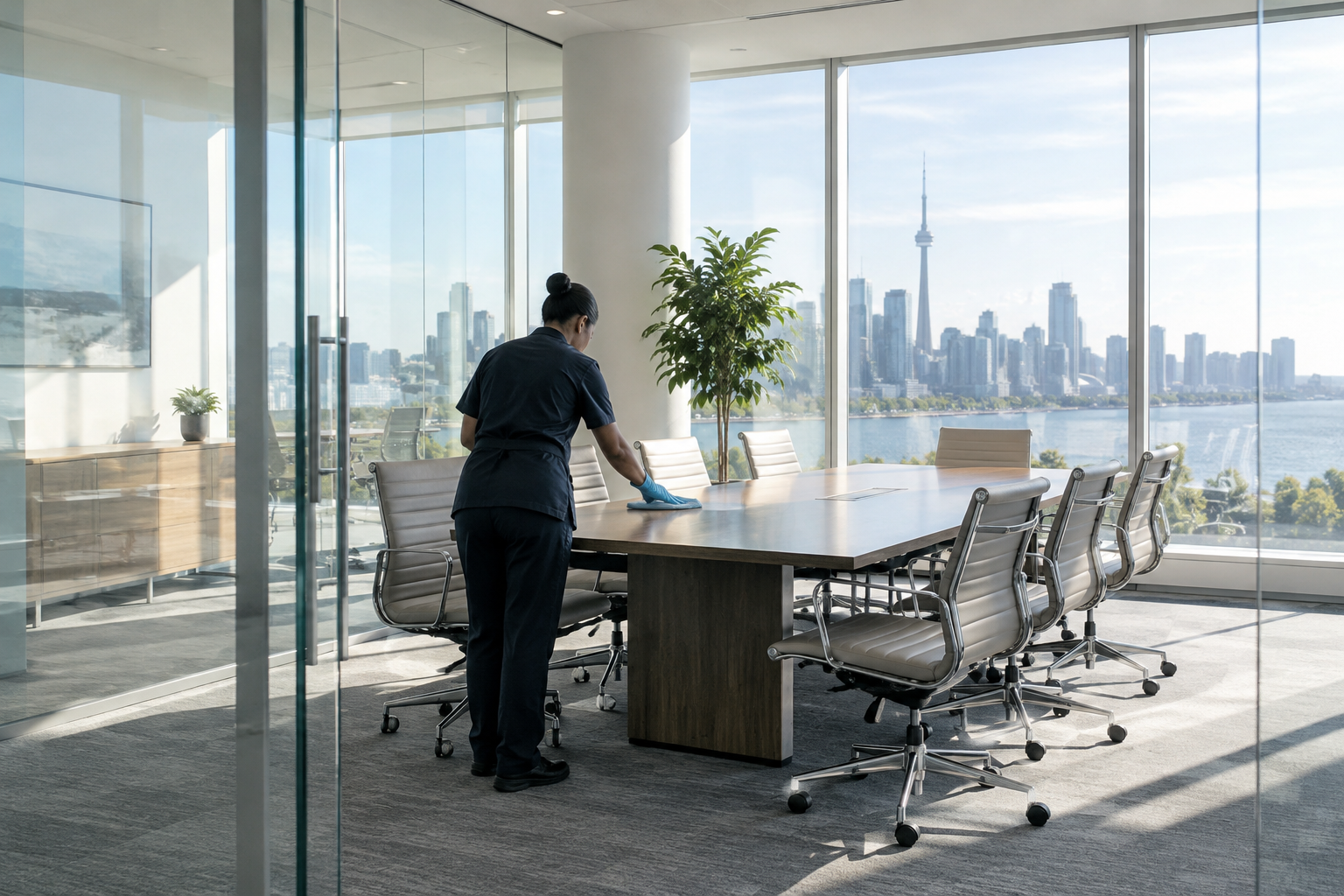
Meeting-room cleaning should leave tables, chairs, touchpoints and floors ready for the next booking without interfering with audiovisual equipment.
A boardroom used for client meetings may need attention sooner than an enclosed office occupied by one person. Include a simple reset process: remove cups and waste, clean the table, check visible marks and return chairs to their agreed positions.
Specify responsibility for door handles, booking panels and shared controls, using manufacturer-compatible methods. Screen cleaning, cables and equipment adjustments should remain outside routine work unless expressly included.
In busy Toronto professional offices, coordinate service with reception or the booking calendar. Daytime resets and after-hours floor cleaning solve different problems; specify both if the room's use requires them.
What should kitchen and washroom cleaning include?
Kitchens and washrooms need explicit task lists that separate soil removal, appropriate disinfection and supply replenishment.
These spaces generate complaints quickly because employees notice a dirty sink or empty dispenser immediately. “Clean kitchen” is too vague for a service agreement.
Kitchen and lunchroom scope
Include counters, sinks, taps, tables, appliance handles, bin exteriors and floors. State whether microwave interiors, fridge interiors, dishwashing and dishwasher loading are included or excluded.
For food-contact surfaces, follow the product label, including any required rinse. Set a separate policy for food disposal; cleaners should not decide which unlabelled lunches to throw away.
Washroom scope
Include toilets, urinals where present, basins, taps, mirrors, dispensers, partitions, door touchpoints and floors. Identify who purchases supplies and who checks stock between cleaning visits.
Cleaning removes dirt; disinfection requires an appropriate product used according to its label, including contact time. For disinfectants used in Canada, check the Drug Identification Number and intended use rather than relying on a general “antibacterial” claim.
Persistent odours, leaks or recurring blockages should be reported for investigation, not simply covered with fragrance.
Which tasks are usually outside routine office cleaning?
Periodic restoration, specialist equipment cleaning and work in restricted areas should be separately defined rather than assumed to be part of every visit.
Potential exclusions include:
- Carpet extraction and upholstery cleaning.
- Machine floor maintenance or finish restoration.
- High-access dusting and exterior window cleaning.
- Post-construction dust removal.
- Server equipment, electrical panels and technical machinery.
- Hazardous materials or unusual contamination.
For server and records rooms, specify whether trained, authorized cleaners may enter and which surfaces they may touch. Access permission alone does not establish an appropriate cleaning method.
Discuss specialty cleaning services when routine maintenance no longer addresses embedded soil or a particular material needs different care. Keep these tasks visible in the annual maintenance plan so they do not become surprise requests.
How should hybrid work and sustainability change the schedule?
Hybrid work should shift cleaning effort towards busy areas and occupied days, while sustainability should guide product selection, dosing and waste handling.
Review attendance patterns alongside meeting bookings and complaints. If employees cluster their visits on particular days, those days may need stronger washroom checks, kitchen attention and shared-desk coverage. Quiet periods are better opportunities for unobstructed detailing.
For practical environmental improvements:
- Ask for product labels and safety data sheets, not vague “green” promises.
- Use products suitable for the surface and task at the correct dilution.
- Separate washroom tools from kitchen and workstation tools.
- Maintain entrance mats to limit soil spreading through the office.
- Follow the building's actual recycling and organics arrangements.
A low-odour product is not automatically safer or environmentally preferable. Match cleaning and targeted disinfection to the task, rather than applying disinfectant indiscriminately throughout the office.
What affects office building cleaning costs in Toronto?
Office cleaning costs depend on square footage, frequency, traffic, washroom demands, flooring and special requirements, together with the site's access conditions.
Two similarly sized offices can require different workloads. One may have mostly enclosed offices and light attendance; another may have shared desks, frequent visitors and heavily used kitchens.
Toronto buildings can also have loading-dock bookings, service-elevator windows, security sign-in procedures and restricted waste-room access. Identify these before quoting because they affect how work is organized.
Use the office cleaning pricing guide to understand the cost drivers, then request a quote against your written scope. Compare inclusions, periodic tasks, consumables and service frequency—not just the headline price.
How do you choose and manage an office cleaning provider?
Choose a provider that can turn your walkthrough into a clear scope and demonstrate how missed tasks, access issues and changing occupancy will be handled.
Ask who supervises the work, how replacement coverage is arranged and what happens when a recurring concern is reported. Request insurance documentation and clarify site orientation requirements before granting access.
Arelli uses local crews, not a franchise, and serves 300+ Ontario businesses. Its client care process includes 24/7 client support and an app for reporting concerns and following up; support availability should not be confused with an agreed on-site response time.
For ongoing office cleaning, review concrete outcomes: empty dispensers, missed bins, visible salt residue and unresolved reports. Specific observations are more useful than a general cleanliness score alone.
Frequently asked questions
These answers address common decisions when setting a Toronto office building cleaning scope.
Is daily cleaning necessary for a hybrid office?
Not every room needs identical daily service. Base the schedule on actual use, while ensuring occupied washrooms, food areas and shared workstations receive appropriate attention.
Does office cleaning include disinfecting every surface?
No; the scope should identify which surfaces require disinfection and when. The provider should follow product-label directions and surface compatibility requirements.
Who cleans shared building washrooms?
Responsibility depends on the lease and building service arrangement. Confirm it with property management and record the boundary in the cleaning scope.
Are kitchen appliances included?
Appliance exteriors and handles may be included, but interiors need explicit agreement. Fridge cleaning also requires a food-removal policy and coordination with employees.
Can cleaners work while employees are present?
Yes, if tasks and access routes are planned around occupants. Schedule disruptive work separately and use appropriate controls whenever cleaning leaves a floor wet.
Get a free sample clean
A free 45-minute sample clean lets your Toronto team assess Arelli's work before committing. Bring your floor plan, priority rooms and current concerns so the conversation starts with a practical scope.
Book a free sample clean or request a quote to discuss coverage for your office building.
Arelli service for this topic
Commercial Cleaning in Toronto