
A janitorial checklist prevents missed tasks when it identifies the exact area, required action, timing, responsible person and method of confirming completion. For Toronto businesses, it should also account for winter salt and slush, hybrid-work traffic, daytime cleaning gaps and Ontario’s washroom cleaning-record requirements effective in 2026. Use the checklist as a shared operating document—not simply a list the evening cleaner signs.
Key takeaways
- Give every task a location, completion standard, owner and scheduled trigger.
- Separate routine cleaning from daytime response, periodic work and maintenance responsibilities.
- Adjust coverage to actual occupancy, weather and shared-space use.
- Keep required washroom cleaning records accessible; recording two recent cleanings does not mean cleaning twice daily.
- Record blocked or incomplete work and verify that it was resolved.
Build the checklist around where tasks get missed
A Toronto office can have clean desks and still generate complaints because the kitchenette sink smells, the entrance mat stays saturated or the accessible washroom runs out of soap. These are often handover failures: the task was vague, nobody owned it during business hours, or the cleaner could not access the area.
Start with a walkthrough during normal operations. Include the office manager, cleaning contact and someone who understands building responsibilities. In a multi-tenant building, distinguish the leased premises from shared washrooms, corridors, loading areas and entrances managed by the landlord.
The CCOHS workplace housekeeping guide recommends assigning responsibility for cleanup during shifts, routine cleaning, waste disposal and inspections. It also identifies easily overlooked areas, including shelves, basements and boiler rooms. This is Canadian safety guidance, not an Ontario statutory cleaning schedule; restricted or technical spaces still need appropriate access and responsibility arrangements.
For each checklist entry, capture:
- Location: identify the room or zone, rather than writing “all areas.”
- Task and standard: describe what must be done and what acceptable completion looks like.
- Timing: specify the service visit, periodic schedule or condition that triggers action.
- Owner: name the contractor, workplace staff or building-management role responsible.
- Status: record completed, blocked, not required or escalated.
- Follow-up: identify who will resolve an exception and when.
A clear commercial cleaning scope should match this document. A checklist cannot fix a contract that leaves responsibility undefined.
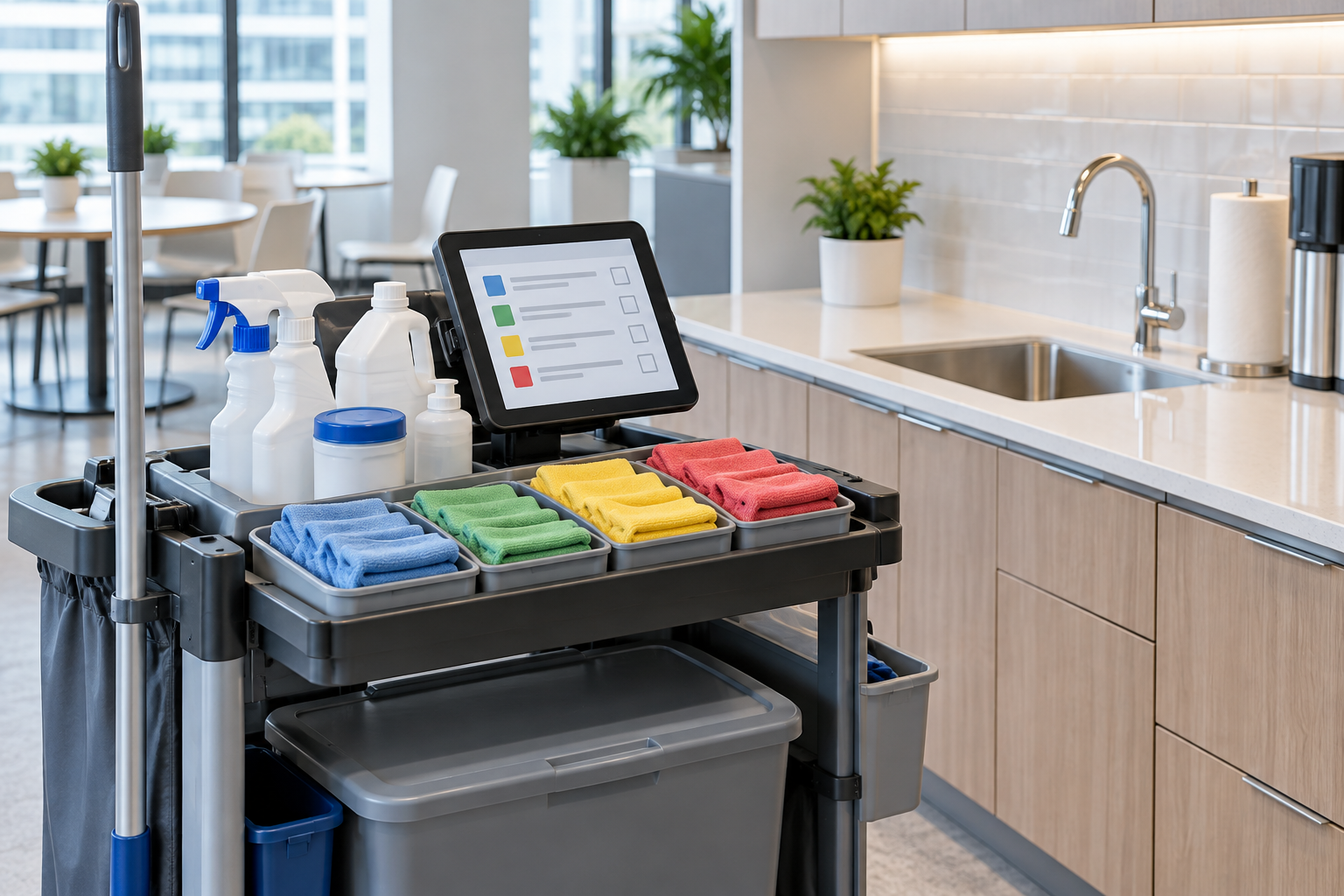
A practical janitorial checklist for Toronto workplaces
Use this table as a starting point for an ordinary office or commercial workplace. The suggested timing is an operational planning framework, not a universal legal schedule. Adjust it for occupancy, risk, service hours and any setting-specific requirements.
| Area | Checklist task and completion standard | Suggested timing or trigger | Ownership and verification |
|---|---|---|---|
| Entrances and interior mats | Remove tracked-in soil, address moisture and inspect mat edges | Each service visit; extra checks during wet or snowy weather | Cleaning team for agreed indoor tasks; workplace contact for daytime issues |
| Washrooms | Clean fixtures and floors, replenish agreed supplies, remove waste and address high-touch surfaces | Scheduled service plus checks based on use | Cleaning team records work; employer confirms record access and supply responsibilities |
| Kitchenettes and eating areas | Clean sinks, counters, tables and agreed appliance surfaces; remove food waste | Scheduled service; spills addressed promptly | Define staff cleanup versus contractor tasks |
| Shared touchpoints | Clean and disinfect designated handles, switches, counters and shared equipment surfaces | Public-health guidance and site protocols; increase attention when visibly dirty | Identify surfaces explicitly and follow product instructions |
| Workstations and meeting rooms | Clean accessible surfaces and floors without disturbing papers or equipment | Agreed service schedule, adjusted to room use | Staff provide access; cleaner flags blocked surfaces |
| Floors and circulation routes | Remove debris and soil; leave routes clear and control wet-floor exposure | Each service visit; prompt response to spills | Cleaner handles agreed tasks; site contact escalates hazards |
| Waste and recycling stations | Empty agreed containers, address residue and keep streams separated | Service schedule and before overflow | Specify bin locations, liner responsibilities and collection route |
| Ledges, corners and low-use rooms | Check for dust, cobwebs and accumulated debris | Named rotating schedule, with additional checks as needed | List individual locations and completion dates |
| Periodic floor and detail work | Inspect buildup and complete separately scheduled treatment | Condition, flooring requirements and agreed plan | Confirm whether included or separately quoted |
The CCOHS general inspection checklist supports checks for clean floors, wet-floor warnings, clear aisles, sanitary washrooms, spill cleanup and unobstructed exits. It also covers outdoor snow and ice and other conditions that may belong to maintenance or building management—not automatically the janitorial contractor.
Replace vague tasks with observable results
“Clean kitchen” leaves too much room for interpretation. A useful entry might read: “Kitchenette: remove crumbs and residue from counters, clean sink and faucet, wipe table surfaces, empty designated waste containers and clean floor.”
Add exclusions beside the task. Refrigerator interiors, dishwashing, personal mugs, food disposal and cabinet interiors need explicit agreement. Otherwise, staff and cleaners may each assume the other party handles them.
Set frequency around occupancy, weather and hygiene
Hybrid work changes the busy days
A fixed schedule can miss a Toronto office’s heaviest use. If team attendance clusters around shared meeting days, washrooms and lunch areas may need more attention then, while unused workstations need less repetitive work.
Review meeting-room bookings, attendance patterns and complaints together. Keep service aligned with occupied zones without allowing quiet rooms to disappear from the checklist. Businesses using shared office spaces should also define who resets rooms between bookings and who reports spills during the day.
Winter requires an indoor–outdoor handover
Toronto snow, slush and de-icing residue create work at entrances that an overnight visit cannot fully manage. Identify who checks mats, responds to wet floors and contacts building management about exterior conditions.
Do not combine “winter entrance care” into one unchecked assumption. Indoor floor care, mat servicing, exterior snow removal and drainage problems can involve different providers. Record the handover rather than expecting the cleaning crew to solve every entrance issue.
High-touch surfaces need a defined hygiene plan
For respiratory-virus prevention in public settings, Toronto Public Health recommends cleaning and disinfecting indoor high-touch surfaces at least daily and when visibly dirty. Examples include handles, switches, counters, sinks, faucets and electronic devices. Remove visible dirt before disinfecting and follow product instructions, including the applicable contact time.
This is public-health guidance, not a universal legal cleaning frequency. Clinics, childcare settings and other specialised environments need their own applicable protocols. For electronics, use methods compatible with both the equipment and product instructions.
Add Ontario’s 2026 washroom records to the handover
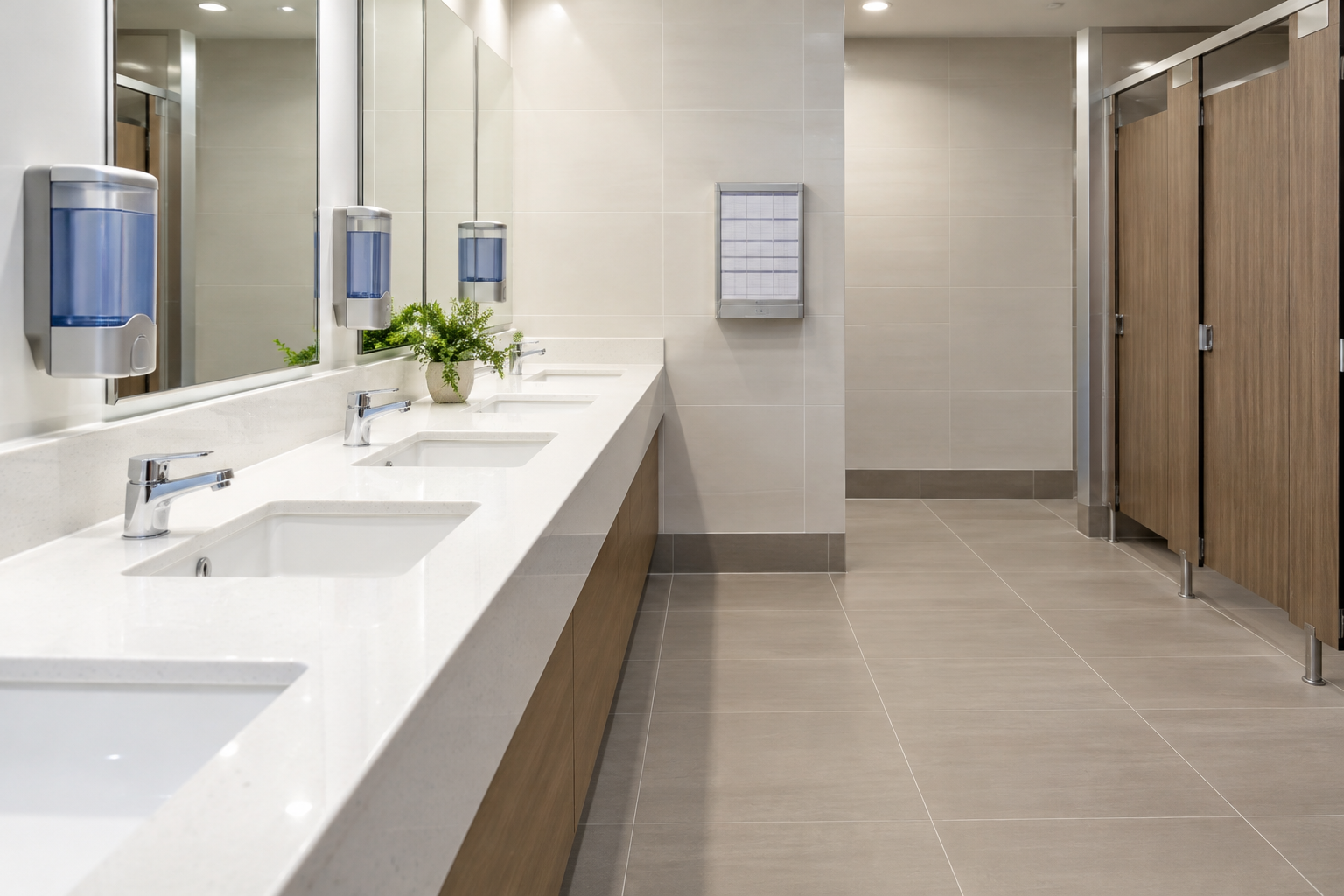
Effective January 1, 2026, Ontario Regulation 480/24 on washroom cleaning records specifies that records include the date and time of the two most recent cleanings. For covered workplaces and washrooms provided for workers, employers or constructors can make records available by posting them conspicuously in or near the washroom, or electronically with directions explaining how workers can access them.
Two recorded cleanings does not mean a requirement to clean twice daily. The recordkeeping provision should not be used to infer cleaning frequency.
Build the record process into the service handover:
- Identify who enters the actual cleaning date and time.
- Confirm where workers can find the record.
- Distinguish a supply inspection from completed cleaning.
- Decide how records remain accessible when cleaning personnel change.
- Have the responsible workplace representative confirm the arrangement meets applicable requirements.
A general work-order completion notice may not communicate the required washroom details. Check the actual record rather than assuming an app notification or invoice is enough.
Close the loop on blocked and missed work
A locked boardroom should not receive a completed checkmark. Neither should a countertop covered with confidential documents.
Use a simple exception entry: location, unfinished task, reason, immediate action, responsible contact and next opportunity to complete it. For example: “Meeting room floor not cleaned because the room remained occupied; office contact to confirm access for the next agreed visit.”
Inspection should compare the result with the checklist standard. Rotate attention across areas rather than checking only reception every time. Repeated misses usually point to an underlying issue: inadequate access, unrealistic timing, missing supplies, unclear scope or insufficient coverage.
Arelli’s client app supports reporting concerns and following up. Pair it with a defined client-care process, especially when an issue needs action before the next scheduled visit. Reporting a problem is not the same as confirming that it has been corrected.
Use the checklist to compare scope, cost and products
When choosing a janitorial service in Toronto, give prospective providers the same room list and task requirements. Ask them to identify exclusions, periodic work, daytime coverage and the process for resolving missed tasks. This makes quotes more comparable than a general promise to “clean the premises.”
Cost depends on square footage, service frequency, traffic, washroom count and use, flooring, and special requirements. Access restrictions, product requirements and periodic detail work also affect the work plan. Use Arelli’s office cleaning pricing guide to understand cost drivers rather than treating a generic rate as a site-specific quote.
For sustainability, request a product and procedure discussion—not just the word “green.” Ask about surface compatibility, correct dilution, waste handling and whether selected products meet the intended cleaning or disinfection task. Never assume a general cleaner is a disinfectant, mix chemicals or substitute a product contrary to its instructions.
Separate routine service from specialty cleaning, such as separately scoped periodic floor or detail work. A checklist is most useful when it makes these boundaries visible before complaints arise.
Frequently asked questions
What should a commercial janitorial checklist include?
Include entrances, washrooms, kitchenettes, shared touchpoints, occupied rooms, floors, waste stations and easily overlooked areas. Each entry needs a task, timing, owner and completion status, plus a way to record blocked work or exclusions.
How often should a Toronto business receive janitorial service?
Frequency should reflect occupancy, traffic, washroom use, food areas, operating hours and the setting’s hygiene requirements. Review busy hybrid-work days and winter entrance conditions separately; some needs require daytime response rather than another overnight task.
Are Toronto workplaces required to keep washroom cleaning records in 2026?
For covered workplaces under Ontario’s occupational health and safety framework, the regulation effective January 1, 2026 specifies records showing the date and time of the two most recent cleanings. Records must be available through the permitted posted or electronic arrangements. That requirement does not establish twice-daily cleaning.
What is commonly excluded from routine janitorial service?
Possible exclusions include refrigerator interiors, dishes, exterior snow removal, maintenance repairs and periodic floor restoration. There is no universal package: confirm inclusions and exclusions in the written scope rather than assuming they belong to routine service.
How can managers verify cleaning without checking every room?
Use rotating inspections, review exception reports and track recurring complaints by location and task. Check whether corrective actions were completed, not simply whether a message received a reply. Increase attention where the same issue keeps returning.
Can a sustainable cleaning plan still meet hygiene expectations?
Yes, provided product selection and procedures fit the required task and setting. Follow labels, distinguish cleaning from disinfection and avoid unsupported environmental claims. The checklist can also address accurate dosing, appropriate reusable tools and correct waste separation.
Get a free sample clean
Bring your room list, recurring complaints and access requirements to a discussion about Arelli’s commercial cleaning services. Arelli offers a free 45-minute sample clean before you commit, giving you an opportunity to discuss priorities and assess the work firsthand.
Book a free sample clean for your Toronto business and start building a clearer, more accountable cleaning scope.
Arelli service for this topic
Commercial Cleaning in Toronto