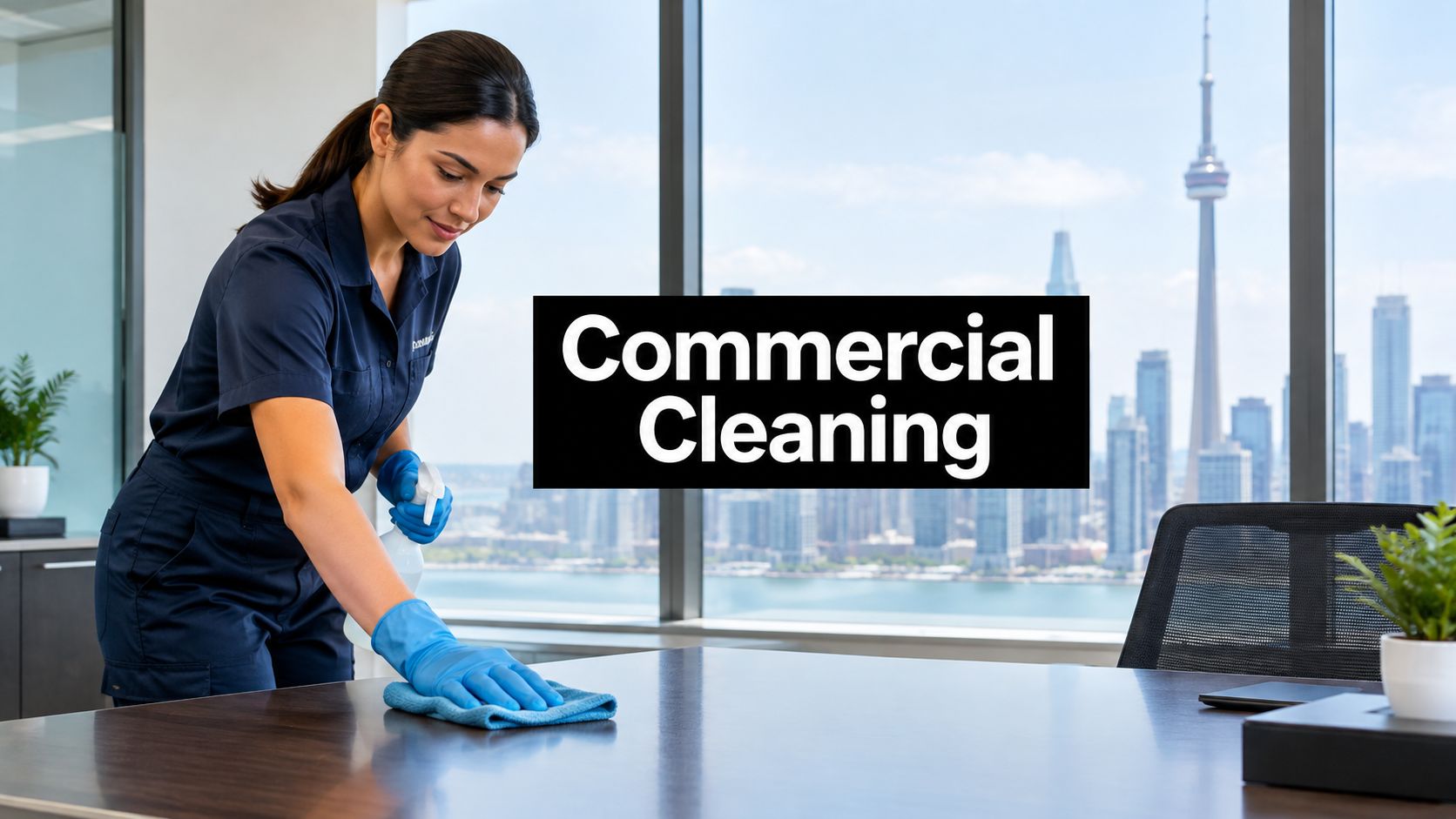
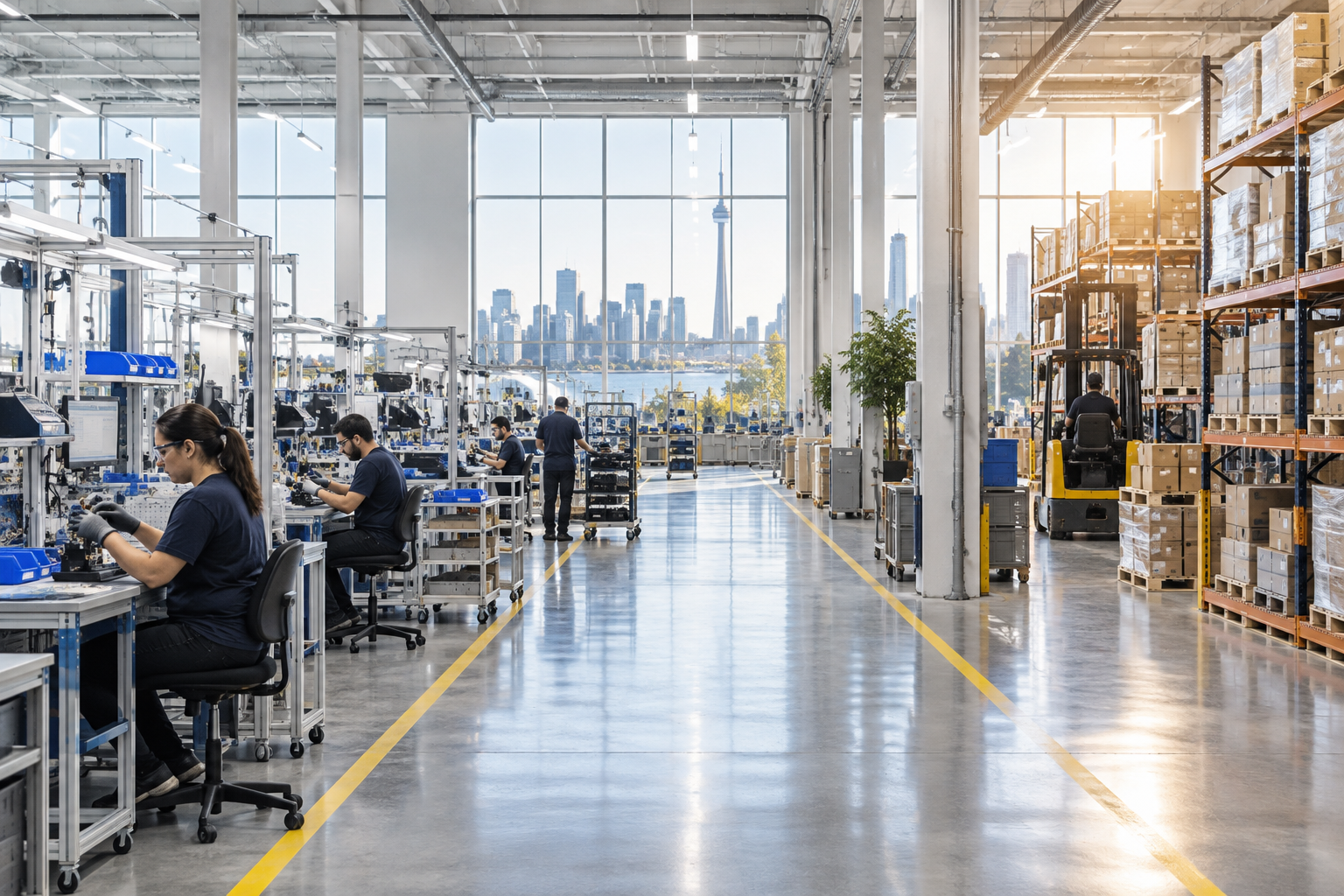
Industrial facility cleaning in Toronto works best when the cleaning plan separates routine housekeeping from hazardous or process-specific work, controls dust at its source, and fits around production and vehicle traffic. Facility managers should assign cleaning frequencies by zone, agree on safe access windows, and compare quotes against the same written scope—not just building size.
Key takeaways
- Separate employee areas, warehouse aisles and production zones, with clear responsibility for each.
- Identify dust before choosing a removal method; ordinary janitorial equipment is not suitable for every industrial residue.
- Schedule floor work around shipping, shift changes and production shutdowns.
- Add winter entrance and loading-area checks for Toronto’s salt, slush and wet-weather traffic.
- Compare cleaning proposals by tasks, frequency, access requirements and exclusions.
What should industrial facility cleaning in Toronto include?
Industrial facility cleaning should cover agreed building housekeeping tasks without automatically extending to machinery, hazardous materials or production sanitation.
In Toronto’s Industrial & Manufacturing facilities, the same building may contain a reception area, lunchroom, warehouse, assembly floor and shipping department. Each has different cleaning needs. A tidy office does not tell you whether the warehouse perimeter is accumulating dust or the employee washroom needs more frequent attention.
A practical routine scope can include:
- Cleaning employee washrooms, change areas and lunchrooms.
- Emptying designated general-waste and recycling containers.
- Vacuuming or damp-cleaning accessible surfaces using suitable methods.
- Cleaning approved pedestrian routes and accessible floor areas.
- Removing tracked-in soil from entrances and reception areas.
- Cleaning shared touchpoints such as door handles and lunchroom tables.
Machinery interiors, elevated structures, hazardous residues, process waste and confined spaces should be explicitly included or excluded. Arelli’s industrial and trade facility cleaning services provide a starting point for discussing the building’s needs; a walkthrough should establish the actual scope.
How do you control dust without spreading it through the facility?
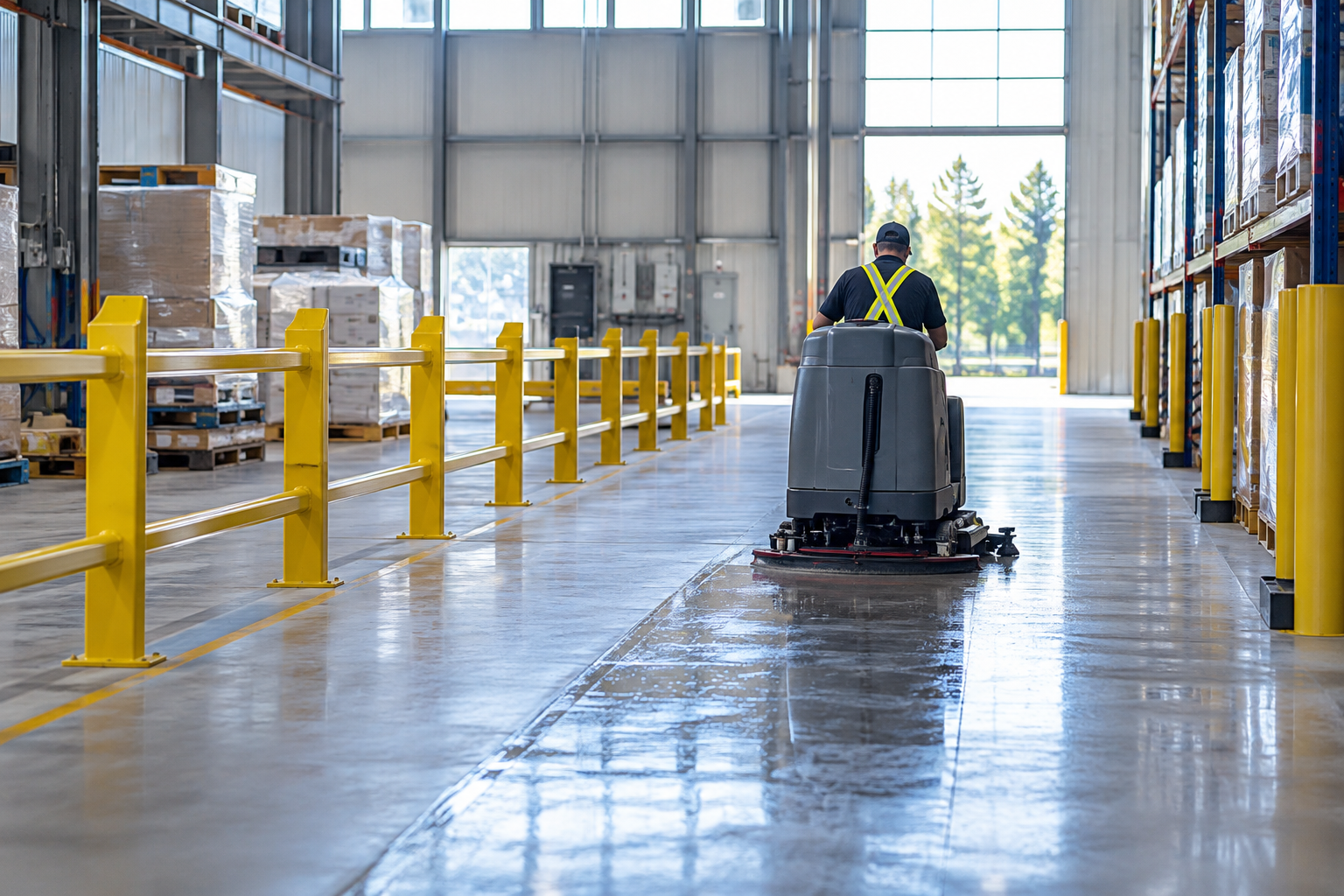
Effective dust control starts by identifying the material, limiting its spread and choosing a collection method appropriate to its hazards.
Dust from packaging is not necessarily managed the same way as metalworking residue, wood dust or fine process powders. Ask the production lead what generates it, where it travels and whether safety data sheets or a hazard assessment affect the cleaning procedure.
Avoid treating compressed air or dry sweeping as the default answer. Both can put settled material back into the air. Where appropriate, suitable filtered vacuuming or damp methods can reduce redistribution, but equipment must be compatible with the substance and environment.
Set a boundary for hazardous dust
If combustible dust or hazardous residue may be present, stop and involve the facility’s health and safety lead before selecting equipment. A HEPA filter alone does not make a vacuum suitable for combustible dust. Routine cleaning also does not replace process ventilation, dust collection or an engineered control system.
For ordinary housekeeping dust, inspect recurring accumulation points: accessible ledges, floor edges, packaging areas and the transition between production and offices. Clean within the approved scope and record where buildup returns. That pattern may reveal a source-control problem that more frequent mopping cannot solve.
How often should an industrial facility be cleaned?
Cleaning frequency should follow soil generation, employee use and exposure risk rather than a uniform calendar for the entire building.
Use the following as a planning framework, not a universal service specification. Confirm frequencies after observing the site during production and shipping—not only when the building is quiet.
| Area | Suggested planning frequency | What to check |
|---|---|---|
| Employee washrooms | Each operating day, with checks between shifts as needed | Fixtures, floors, soap, paper supplies and waste |
| Lunchrooms and break areas | Each operating day; additional resets after busy breaks | Tables, counters, sinks, spills and bins |
| Entrances and pedestrian transitions | Each operating day; more often during wet weather | Slush, salt, mat saturation and tracked-in grit |
| Warehouse pedestrian routes | Inspect each shift; clean in approved access windows | Loose debris, floor residue and obstructions |
| Production-zone floors | According to process needs and safe release windows | Residue type, equipment boundaries and approved methods |
| Accessible ledges and perimeter surfaces | Scheduled after reviewing buildup | Dust accumulation and safe reach |
| Elevated or process-sensitive areas | Separately planned | Access controls, specialist requirements and shutdown needs |
When a new line starts or overtime increases, review the schedule. Hybrid attendance may reduce demand in administrative offices while production washrooms and lunchrooms remain heavily used. Adjust by zone rather than cutting the whole building’s cleaning frequency.
How can cleaning fit around production and forklift traffic?
Cleaning should take place in agreed work windows with clear separation from moving vehicles, active equipment and sensitive production activities.
A cleaner should not have to negotiate access with a forklift operator in a live aisle. Before service begins, mark approved routes, identify restricted areas and agree on who can release a zone for cleaning.
For Toronto facilities serving regional delivery routes, dispatch activity may continue after office staff leave. “After hours” therefore needs a site-specific definition. Ask shipping and production supervisors when access is actually available.
Build a usable access plan
- Identify shift changes, break periods and dispatch peaks.
- Divide large floor areas into sections that can be safely released.
- Keep cleaning equipment and cords out of active vehicle routes.
- Use barriers and site-approved traffic controls for wet work.
- Allow floors to dry before reopening affected routes.
- Define who authorizes access and who confirms the area is ready for use.
Cleaning near machinery must follow the facility’s safety procedures. Where servicing or cleaning requires hazardous energy isolation, authorized personnel must manage that process. A janitorial schedule is not permission to reach into equipment or bypass guarding.
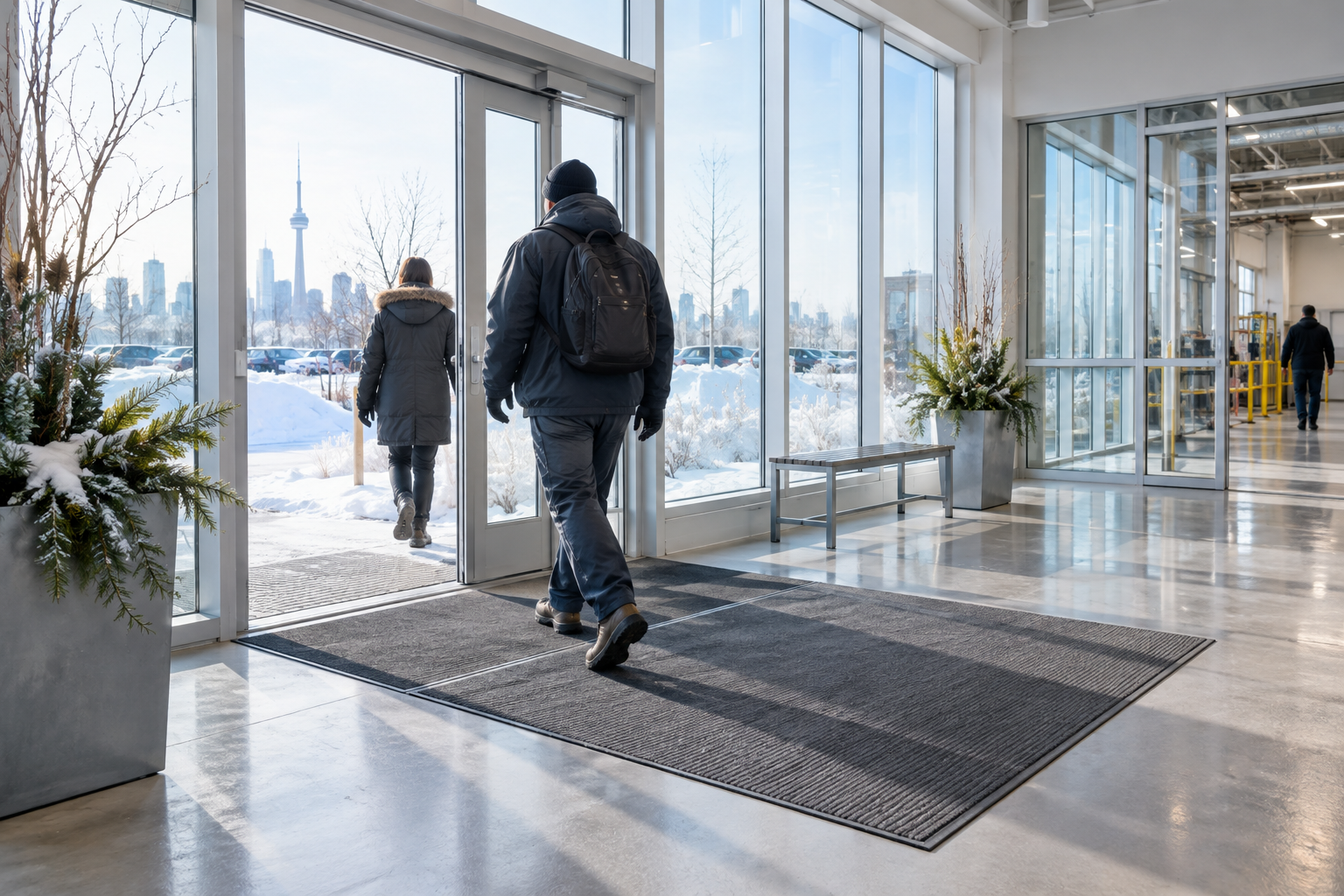
What changes during a Toronto winter?
Toronto winter cleaning needs extra attention at entrances, dock-adjacent pedestrian routes and places where outdoor footwear crosses into clean indoor areas.
Industrial properties in Etobicoke, North York and Scarborough can have several staff entrances alongside shipping doors. Maintaining only the front lobby leaves other entry points carrying salt and grit into the building.
Walk the route employees actually take from parking or transit to their workstations. Check whether mats lie flat, become saturated or allow moisture to migrate onto smooth floors. Coordinate snow and ice maintenance with indoor cleaning so responsibility does not disappear at the doorway.
At loading areas, separate ordinary tracked-in soil from leaks or unknown industrial liquids. An unidentified spill needs the facility’s response procedure, not an improvised mop-up.
Review floor-product compatibility before tackling salt residue. The aim is to remove soil without damaging coatings or leaving a slippery film. Toronto’s changing weather also makes condition-based checks more useful than waiting for the next scheduled visit.
How much does industrial cleaning cost in Toronto?
Industrial cleaning costs depend on the work required, how often it is needed and how safely and efficiently crews can access each area.
Square footage is only the starting point. An open storage area with clear access presents a different workload from a smaller site with crowded workstations, heavy residue and several employee washrooms.
The main cost drivers are:
- Area and layout: cleanable floor space, congestion and travel between zones.
- Frequency and traffic: operating days, shifts, visitors and employee use.
- Washrooms and amenities: fixture counts, lunchrooms and replenishment duties.
- Flooring: surface type, condition, coatings and suitable cleaning methods.
- Special requirements: residue characteristics, restricted access, equipment and supervision.
- Timing: short access windows, shutdown coordination and service changes.
Use Arelli’s cleaning pricing guidance to understand pricing factors, then request a walkthrough-based industrial proposal. Confirm whether consumables, periodic floor work and additional visits are included. Arelli offers Price Match on comparable written quotes; matching the scope is essential to making the comparison useful.
What hygiene and sustainability expectations should the plan meet?
A useful cleaning plan sets task-specific hygiene requirements and reduces unnecessary product use without compromising safety or process compatibility.
Employee washrooms and lunchrooms need consistent cleaning, appropriate disinfection where specified, and reliable supplies. Cleaning removes soil; disinfection is a separate step that requires the correct product and labelled contact time. Neither should be described as making an industrial workplace sterile.
Food, pharmaceutical and other controlled production environments may have validated sanitation requirements. General commercial cleaning should not be assumed to satisfy those requirements without a separately agreed protocol.
For a practical sustainability review, ask about:
- Correct product dilution and compatibility with floor finishes.
- Microfibre systems and separation of washroom tools from break-area tools.
- Equipment maintenance and methods that limit dust redistribution.
- Following the facility’s waste streams rather than mixing sorted materials.
- Fragrance restrictions and substantiation for environmental claims.
A “green” label alone does not establish suitability around production. Review safety data sheets and check for restrictions related to product contact, sensitive materials or employee exposure. Discuss periodic floor restoration or other non-routine tasks separately through specialty cleaning services.
How do you choose an industrial cleaning company in Toronto?
Choose a provider that can translate your production conditions into a documented scope, safe access plan and accountable reporting process.
During the walkthrough, ask how the company handles restricted areas, missed access windows and an unexpected residue. A credible answer may be to stop, secure the area and contact the designated supervisor—not to promise that every material can be cleaned immediately.
Request clarity on site orientation, supervision, insurance, approved products and responsibility for equipment. Then establish a short inspection checklist: entrance condition, washroom supplies, lunchroom surfaces, accessible dust points and completed floor zones.
Arelli uses local crews, is not a franchise and serves 300+ Ontario businesses. Its client care support includes 24/7 client support and an app for reporting concerns and following up. These channels support communication; they do not replace the facility’s emergency response procedures.
For industrial and trade facilities, the best proposal makes exclusions as clear as inclusions. It should also explain how the schedule changes when production expands, a shipment blocks access or a shutdown creates an opportunity for planned cleaning.
Frequently asked questions
Does industrial cleaning include production machinery?
Not automatically. Machine interiors, guards, electrical components and process-contact surfaces need a specifically agreed scope, suitable procedures and authorized access. Keep these responsibilities separate from routine building housekeeping unless the proposal explicitly addresses them.
Can cleaners work while manufacturing continues?
Yes, where the facility can provide safe separation and approved access. Active vehicle routes, exposed processes and machinery hazards may require a different cleaning window or temporary closure of a zone.
Is nightly cleaning enough for a busy Toronto plant?
Nightly cleaning may handle the general reset, but it cannot address every spill, overflowing bin or supply shortage during production. Assign daytime checks to site staff or an agreed cleaning service, with clear escalation for hazards.
Should warehouse floors always be machine-scrubbed?
No; the method depends on the floor, residue and operating conditions. Loose debris may need collection first, and coatings or moisture-sensitive processes can restrict wet methods. Confirm compatibility before making machine scrubbing a standard task.
What should a facility manager prepare before a walkthrough?
Prepare a floor plan, shift schedule, restricted-area list and description of recurring soil or dust. Include current cleaning responsibilities and any relevant product restrictions. Show the provider problem areas during representative operating conditions where safe.
Does Arelli require a long commitment before trying the service?
Arelli offers a free 45-minute sample clean before you commit and has no cancellation fees. Agree on a safe, representative area for the sample; it demonstrates an approach to an agreed task, not every specialist requirement across a plant.
Get a free sample clean
See how an agreed cleaning task fits your Toronto facility before committing. Book a free 45-minute sample clean, and bring your shift schedule, priority areas and access restrictions so the conversation starts with how your building actually operates.
Arelli service for this topic
Commercial Cleaning in Toronto